Oceans are among the largest and most important geographical features on Earth. They cover approximately 71% of the planet’s surface and contain most of its water. These enormous bodies of salt water influence climate, support marine ecosystems and connect continents through natural waterways.
Geographers recognize five major oceans: the Pacific, Atlantic, Indian, Southern and Arctic Oceans. Although they have different geographical characteristics, they form one interconnected global ocean system.
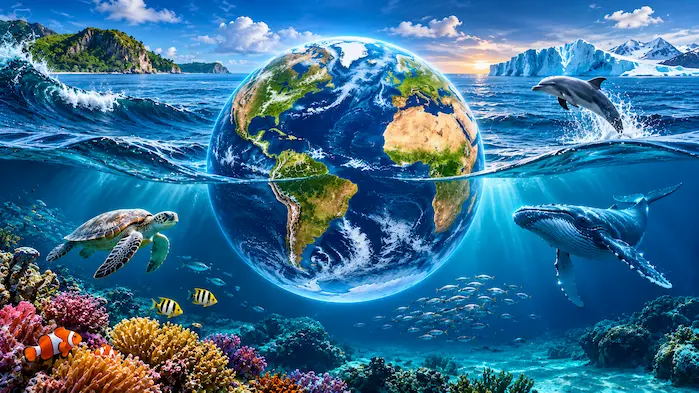
This guide explores the five oceans, their locations, physical features and importance to Earth’s environment.
What Is an Ocean?
An ocean is an extensive body of salt water that covers a large part of Earth’s surface. Oceans contain complex underwater landscapes, marine ecosystems and moving water systems.
They are not isolated from one another. Instead, ocean waters connect across geographical boundaries and circulate through large-scale currents.
Oceans also interact with the atmosphere, land and ice. These connections influence weather patterns, temperature distribution and the global water cycle.
The Five Oceans of the World
1. Pacific Ocean
The Pacific Ocean is the largest and deepest ocean on Earth. It extends between Asia and Australia to the west and North and South America to the east.
It covers an enormous geographical area and contains thousands of islands, underwater mountain ranges and deep ocean trenches.
Important features include:
- Mariana Trench: Contains the deepest known parts of the global ocean.
- Ring of Fire: A region around much of the Pacific characterized by frequent earthquakes and volcanic activity.
- Coral Triangle: A marine region in the western Pacific with exceptionally high coral reef biodiversity.
- Bering Sea: A northern marginal sea between Alaska and eastern Russia.
The Pacific Ocean plays an important role in global ocean circulation and climate systems.
2. Atlantic Ocean
The Atlantic Ocean is the second-largest ocean. It lies between the Americas to the west and Europe and Africa to the east.
Its northern and southern sections connect with other oceans, forming part of the global ocean circulation system.
Important geographical features include:
- Mid-Atlantic Ridge: An underwater mountain system running through much of the ocean.
- Caribbean Sea: A major sea located within the western tropical Atlantic region.
- Sargasso Sea: A region of the North Atlantic identified by ocean currents rather than land boundaries.
- Gulf of Mexico: A large body of water bordered by North America and the Caribbean region.
The Atlantic Ocean has played an important role in transportation, trade, migration and marine research.
3. Indian Ocean
The Indian Ocean is the third-largest ocean. It lies between Africa, Asia, Australia and the Southern Ocean.
Its northern waters experience strong seasonal influences from monsoon winds. These winds affect regional rainfall, ocean circulation and coastal environments.
Important features include:
- Arabian Sea: Located northwest of the Indian Ocean.
- Bay of Bengal: A large bay east of the Indian subcontinent.
- Andaman Sea: A marginal sea near Southeast Asia.
- Mascarene Plateau: An underwater geological feature in the western Indian Ocean.
The Indian Ocean supports marine ecosystems and provides important geographical connections between Africa, Asia and Australia.
4. Southern Ocean
The Southern Ocean surrounds Antarctica and connects the southern parts of the Atlantic, Indian and Pacific Oceans.
It is characterized by cold water, powerful winds, floating sea ice and large-scale ocean circulation.
One of its most important features is the Antarctic Circumpolar Current. This current flows around Antarctica and connects the major ocean basins.
The Southern Ocean supports marine life adapted to cold conditions, including krill, penguins, seals and whales.
Its waters also play an important role in global heat and carbon exchange.
5. Arctic Ocean
The Arctic Ocean is the smallest and shallowest of the five recognized oceans.
It surrounds the Arctic region and is bordered by northern areas of North America, Europe and Asia.
Much of the ocean experiences seasonal sea ice, although the amount and distribution of ice change throughout the year.
Important geographical features include:
- Beaufort Sea: A marginal sea north of Alaska and Canada.
- Chukchi Sea: Located between Alaska and northeastern Russia.
- Barents Sea: Located north of Norway and Russia.
- Greenland Sea: A body of water between Greenland and the Svalbard region.
The Arctic Ocean supports polar ecosystems and influences climate conditions across the Northern Hemisphere.
Comparing the Five Oceans
| Ocean | Main characteristic |
|---|---|
| Pacific | Largest and deepest ocean |
| Atlantic | Second-largest ocean |
| Indian | Strong seasonal monsoon influences in the north |
| Southern | Surrounds Antarctica |
| Arctic | Smallest and shallowest ocean |
The five oceans differ in size, depth, temperature, circulation and geographical location.
How Ocean Currents Work
Ocean currents are large-scale movements of seawater. They transport heat, nutrients and water around the planet.
Several factors influence ocean currents, including wind, Earth’s rotation, differences in water density and the shape of ocean basins.
Surface Currents
Surface currents mainly develop through the influence of global and regional winds.
Earth’s rotation affects their direction through a phenomenon called the Coriolis effect.
These currents transport warm and cold water across large distances.
Deep Ocean Currents
Deep ocean circulation is influenced by differences in water density.
Temperature and salinity affect seawater density. Cold, salty water is generally denser than warmer or less salty water.
These differences help drive large-scale ocean circulation.
Why Are Oceans Important?
Oceans support life and influence several natural processes.
Climate regulation: Oceans absorb, store and transport heat, helping distribute energy around Earth.
Marine biodiversity: They provide habitats for fish, mammals, coral, plankton and many other organisms.
Water cycle: Evaporation from oceans supplies much of the water vapor that enters the atmosphere.
Food resources: Marine ecosystems support fisheries and food supplies for communities.
Transportation: Oceans provide major routes for international shipping.
Scientific research: Ocean studies help researchers understand marine ecosystems, geological processes and climate systems.
Ocean Zones and Marine Environments
Ocean environments vary with depth, sunlight, pressure and temperature.
The upper ocean receives sunlight and supports photosynthesis by marine plants and microscopic organisms.
As depth increases, sunlight decreases. Deeper environments are generally colder and experience much greater pressure.
Marine habitats include coral reefs, seagrass beds, open-ocean waters, coastal wetlands and deep-sea ecosystems.
Each environment supports organisms adapted to its physical conditions.
Frequently Asked Questions
How many oceans are there?
There are five recognized oceans: Pacific, Atlantic, Indian, Southern and Arctic.
Which is the largest ocean?
The Pacific Ocean is the largest ocean by surface area.
Which is the smallest ocean?
The Arctic Ocean is the smallest of the five oceans.
Are all oceans connected?
Yes. The five named oceans form one interconnected global ocean system.
Why is ocean water salty?
Ocean water contains dissolved salts and minerals. These enter the ocean through processes such as rock weathering, river transport and underwater geological activity.
What is the deepest known part of the ocean?
The deepest known parts of the global ocean are located in the Challenger Deep area of the Mariana Trench in the western Pacific.
What is an ocean current?
An ocean current is a continuous or recurring movement of seawater caused by factors such as wind, Earth’s rotation, water density and ocean basin structure.
Understanding Earth’s Oceans
The five oceans form an interconnected system that influences Earth’s climate, ecosystems and geographical relationships. Their currents transport heat, their waters support marine biodiversity, and their coastlines connect countries and continents.
Studying the oceans provides a deeper understanding of the natural systems that shape our planet and the important role water plays in Earth’s environment.